
Do you ever have a day when there are so many things you want and need to do, even things you’re passionate about, and not much happens? You end your day with an even longer to-do list for tomorrow, and you wonder why? Me too. Me too.
It isn’t a lack of willpower. It’s a matter of brain bandwidth. And it has everything to do with your mindset.
What Is Mindset?
Put simply, your mindset is made up of your beliefs, attitudes, perspectives, feelings, and so on, and any of these can be both positive and negative. All of these elements of your mindset determine how you interpret and respond to situations. Your thoughts are a high-value product of your mindset.
I’ve been a student of mindset for decades, and this curiosity with all-things mindset began when I took a class that literally changed my life. During the class, which was about managing your mind, the instructor shared the following thought:
“The consummate truth of life is that we alter our destiny by altering our thoughts. The mind is our most crucial determinant, our crowning asset, our ultimate arena of battle. If we will master the power of our minds, we may do or be whatsoever we will.” ~from The Book on Mind Management by Dennis Deaton
I was so immediately impacted by this quote and this class that I bought Deaton’s book at the conference (Amazon wasn’t even a thing yet!). This book so simply taught just how powerful our minds can be.
Sidenote: Just because I’ve studied mindset for decades does not mean I’ve got my mind mastered. At all. I’m continually learning how to better master my mind, and some days definitely go better than others.
→ Grab your own copy of The Book on Mind Management here.
Why Is Mindset So Important?
Be prepared to be blown away because I think we vastly underestimate the importance of our mindset.
Our mindset is THE foundation for everything we do. Every single action begins with a thought—every. single. one. Think of it like this:
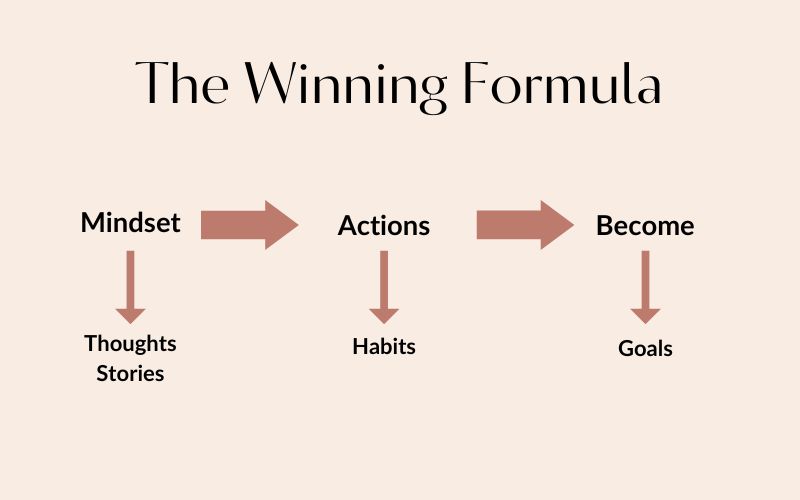
We know that our thoughts are a product of our mindset, but what about the stories we tell ourselves? Stories are just a collection of thoughts, and like with our thoughts, they can definitely affect the actions we take or don’t take.
This formula is also backed up by scripture, which makes this truth even more powerful:
For as he thinketh in his heart, so is he… (Proverbs 23:7 KJV)
Understanding Mental Clutter
Modern neuroscience suggests that we are bombarded with roughly 6,200 thoughts every single day. While there is no solid research, other experts have increased this number into the tens of thousands. Knowing how my brain works, I lean towards those larger figures.
That’s not all.
If we think of our mind as a web browser, each of these thoughts are a tab we keep open. When we have only one or two tabs open, closing those tabs isn’t usually a problem. But for many of us, our mental browser is cluttered with dozens and dozens of thought tabs at the same time:
- Conversations from yesterday. Or from a decade ago.
- That seemingly endless to-do list.
- Problems at work or at home. Or both.
- Concerns about family members.
- Worries or “what ifs” that keep swirling like an E5 tornado in our minds.
- And on. And on. And on.
I don’t know about you, but having too many tabs open makes me feel anxious and overwhelmed and makes it harder to accomplish anything.
As an ACE Certified Behavior Change Specialist, I view this as a massive mental traffic jam where the brain is overwhelmed by too much information, or by too many thoughts, in this case. Because the conscious brain is scientifically wired to focus on only one thing at a time, this multiple-open-tab clutter creates a heavy “switch cost” every time our focus jumps from one random thought tab to another, resulting in the potential for memory issues, increased stress levels, elevated heart rate, and higher blood pressure.
That’s not all.
When you switch back and forth between tasks, researchers found that it can take an average of over 23 minutes to get back to that deep focus that produces the best results. And additional research shows that frequent switching can decrease productivity by as much as 40%, which equates to 3 hours out of an 8-hour workday.
This switch cost can be exhausting both mentally and physically.
If you’ve been feeling stuck in this thought landmine, you don’t necessarily need to “try harder,” or “stop thinking,” which is virtually impossible to do. Instead, strive to learn how to better manage the thoughts that are stealing your attention so you can get back to the things in your life that matter most.
→ How can you better manage your mindset? I’ve got you. This post is the first post in a series of posts on mindset, so stay tuned!
Our Mindset Has Superpowers
Our minds are always thinking. It would need to be continually thinking with those thousands of thoughts it produces every day! But…I think we absolutely underestimate what’s really going on 24/7/365 in that space between our ears and how much our thoughts can affect our actions. Here are a couple of examples that illustrate what’s actually going on in our minds.

Illustration #1. The Analogy of the Chocolate Cake
I can’t find actual science behind what I’m going to share, but I heard this idea in that same class so many years ago. It was powerful for me, so let’s see if it’s powerful for you too.
If I tell you, “Don’t eat the chocolate cake!”, what’s the first image that pops into your mind? If you’re like me and the many people I’ve taught about mindset in the past, the image of a chocolate cake—the BEST multi-layer chocolate cake with lots of chocolate frosting and covered with chocolate shavings—pops into your mind. And you don’t see a big red X over that cake. You see just the cake.
Our minds can’t “see” the word “don’t.” They only see the words that follow. That can be problematic when we’re trying to create a habit where we stop doing something because every time we tell ourselves to stop doing that thing, we “see” just the opposite. It makes it harder to stick to that habit, for sure.
Tip: If you’re trying to create a habit where you want to stop doing something, tweak what you tell yourself. Instead of “Don’t eat the chocolate cake!”, tell yourself, “Eat some fruit…or some vegetables…or some protein…” and so on. It a game-changer!
Illustration #2. The Florida Effect
This illustration might actually blow your mind-set. There is a NYU study1 where two groups of students were given the assignment to make sentences out of a collection of seemingly random words. In group 2’s words were “hidden” words related to old age: Bald, Florida, wrinkle, retired, and gray, but not “old.” At the end of the challenge, both groups were told to walk to the end of the hall to another classroom to complete the study. The researchers timed the students. The group 2 students, who had been exposed to the old-age-related words, walked slower.
Think about it…Something as subtle as random words we see or even hear can have a powerful effect on our minds. That fact, alone, is why it’s important to cultivate and nurture a positive mindset that can serve us in the best ways possible minute after minute, hour after hour, and so on for decades to come.
Another team of researchers in Germany did a similar, but opposite study2 where they had two groups of participants walk around a room, asking one group to walk slower than normal. After the walk concluded, both groups were shown a set of random words, and the slower walking group quickly picked out words related to old age. As author Daniel Kahneman stated, “If you were primed to think of old age, you would tend to act old, and acting old would reinforce the thought of old age.2
The Power of a Positive Mindset
A positive mindset can offer us so many other benefits we might not even associate with the state of mindset and our thoughts:
- Better physical health
- Lower chance of heart attack
- Increased immunity
- Lower blood pressure
- Better stress management
- Improved pain tolerance
- Higher creativity
- Greater problem-solving skills
- Clearer thinking
- Improved mood
- Reduced risk of depression
- Improved coping skills
- Longer life span
10 Tips for Cultivating a Positive Mindset
I know this can all feel so overwhelming and become yet another tab that’s open on the web browser of our minds. But there are some things we can do to cultivate and nurture a positive mindset, and they definitely won’t add even more weight to the mental load we might already be carrying. And like I shared recently, cultivating a positive mindset is all about taking those teeny, tiny steps one after the other. Here are some tips from mindset experts that can help you cultivate a mindset that can serve you now and for decades to come:
Tip #1. Focus on the good. There are so many good things in life, even when times are tough, but we often overlook them, and no matter what is going on, there is always at least one good thing we can discover.
Tip #2. Look for humor. Laughter and fun thoughts can lower depression, anxiety, and stress and improve mood, self-esteem and our ability to cope with life. And humor can’t help but turn that frown into a smile.
Tip #3. Talk kindly to yourself. Let’s get real: You’d never talk to others the way you talk to yourself sometimes. Words matter (Think: Chocolate Cake + The Florida Effect!), and the words you say to yourself about yourself matter the most. After all, your thoughts—including the words you say to yourself in your head—lead to your actions. If you’re feeding yourself negative thoughts about yourself, that can only cultivate the types of actions that won’t get you where you want to go.
Tip #4. Practice gratitude + keep a gratitude journal. Simply being grateful comes with its own long list of physical and mental health benefits, and as we look for things to be grateful for—even the simplest things, we’ll notice even more. To get the most out of your gratitude practice, experts suggest that writing down what you’re grateful for can help cultivate that positive mindset even more!
→ Click here to learn more about the importance of gratitude.
Tip #5. Spend time with positive people. We often reflect the moods, opinions, and so on of those we spend the most time with. If your crowd is often negative, that can definitely affect your mindset. Better yet, be a positive person for those around you! Your positivity can rub off on them, which can then reflect right back onto you.
Tip #6. Know where the negative spaces are in your life. We can’t “fix” what we don’t recognize. Are there things, or situations, and/or people in your life that are consistently negative or that are negatively affecting your mindset? Seek them out, and then make it a goal to change those spaces or even remove yourself from those spaces if possible.
Tip #7. Begin each day with a happy thought. I often find myself thinking about my to-do list, something I’m stressed or anxious about, or other negative things the second my eyes open for the day. I’ve been working on the habit of saying a prayer the minute I wake up, which has gone a long way towards helping me start my days in happy ways. Other ideas? Think of 3 things you’re grateful for, picture loved ones (my cute grandsons bring a smile to my face every time!), something you’re excited about, a favorite vacation spot, and so on. Anything happy and positive can work!
Tip #8. Practice self-care.3 Remember the oxygen mask instructions we hear every time we board a flight? They’re actually very wise. If we’re not taking care of ourselves, it’s harder to take care of those who depend on us. Self-care doesn’t mean taking hours and hours away from your already way-too-busy life. It could be as simple as taking a few minutes to breath, going for a short walk, reading a few pages of a favorite book, doing a hobby, taking a quick nap, or anything else that helps you take better care of YOU. One thing I’ve discovered is that my mindset takes a huge hit in not-so-good ways when I’m not getting enough sleep.
B Tip #9. Be present. For me, those negative thoughts seem to overwhelm me when I’m worried about something in the future (which I often have very little control over), or dwelling on something in the past (which I can do nothing about!), or something on my to-do list, and so on. If I can bring myself back to the present, those negative thoughts don’t have such a strong hold on me. As Master Oogway so eloquently stated in Kung Fu Panda,
“Yesterday is history, tomorrow is a mystery, but today is a gift. That is why it is called the present.”
Take advantage of the gift of the present and watch your mindset grow by leaps and bounds!
Tip #10. Focus on your strengths and positive qualities. It’s so easy to see all the amazing things others are doing but forget about all the ways we’re flourishing. Do some brainstorming and make a list about everything that’s so awesome and unique about you. Don’t hold back—this list is just for you. When you find your mindset heading in a negative direction, pull out that list and reflect on how incredible you are. This practice might feel a bit uncomfortable at first, but it can quickly help turn the negative into the positive.
A positive mindset can literally be life- and soul-changing, and as we strive to create a positive mindset, our thoughts can lead to actions that will help us become who we—and God—want us to become.
Now it’s your turn. Begin with one tip from above or one of your own and watch how powerful tiny, positive steps can help calm the constant clutter in your mind. And if you have your own ways of cultivating a positive mindset, please share them in a comment below!
Related reading:
How to Stop Breaking Promises to Yourself: The Secret to Personal Integrity
Creating Habits and Achieving Goals: Replace an Unwanted Behavior with a New Behavior
How Do You Talk to Yourself?
From “Have To” to “Get To”: The Power of Gratitude in Daily Habits
Sources:
1 John A. Bargh, Mark Chen, and Lara Burrows, “Automaticity of Social Behavior: Direct Effects of Trait Construct and Stereotype Activation on Action,” Journal of Personality and Social Psychology 71 (1996): 230–44. words related to old age: Thomas Mussweiler, “Doing Is for Thinking! Stereotype Activation by Stereotypic Movements,” Psychological Science 17 (2006): 17–21.
2 Daniel Kahneman, Thinking, Fast and Slow (New York: Farrar, Straus and Giroux, 2015). 53-54.
*As an Amazon Associate, I earn from qualifying purchases at no extra cost to you.* Access my General Disclaimer here.



Leave a Reply